Osage Reservation
Killers of the Flower MoonThe Osage Reservation is both a homeland repeatedly reduced by outside power and a place where the Osage secured an enduring claim to the minerals beneath the soil. Its history moves from forced cessions and removal through allotment and the oil boom to contemporary disputes over resource extraction. In the book, the reservation is not simply a landscape behind the murders: control of its land, wealth, and memory shapes what happened there and what remains at stake.
From dispossession to a new homeland
The Osage had long occupied lands that the United States sought to control. After the United States acquired the Louisiana Territory in 1803, President Thomas Jefferson met Osage leaders the next year and spoke of friendship and kinship. Within four years, however, the Osage had been compelled to relinquish territory between the Arkansas and Missouri Rivers. Over the following two decades, they ceded nearly one hundred million acres and eventually found refuge in a 50-by-125-mile area in southeastern Kansas.
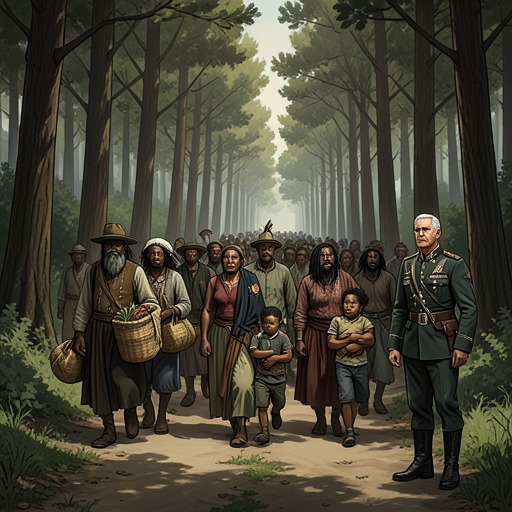
That refuge was taken as well. In 1870, after being expelled from their homes and having graves plundered, the Osage agreed to sell their Kansas lands to settlers for $1.25 an acre. Settlers had already attacked and killed Osage people, mutilating and scalping some of them. Seeking another home, the Osage considered buying nearly 1.5 million acres from the Cherokee in what was then Indian Territory. Many white officials dismissed the hilly country as barren and unfit for cultivation. Wah-Ti-An-Kah argued that those hills might deter white settlement and help the Osage keep a home. The tribe purchased the land for seventy cents an acre and began its migration in the early 1870s.
The move was not merely a change of address. A witness recalled the grief of people leaving the graves of their children behind. In the new reservation, Osage families established settlements including Pawhuska and Gray Horse. Mollie’s parents, Lizzie and Ne-kah-e-se-y, married in 1874 and settled at Gray Horse. The region’s physical character would later be recast as a source of wealth: land thought too rocky and hilly for white farmers lay above vast oil deposits.
Allotment and the underground reservation
By the late nineteenth century, federal policy again threatened Osage control of their homeland. Allotment proposed dividing the reservation into individual parcels and opening the remaining land to settlers. It was part of a broader effort to end communal life and convert Indigenous land into private property, making its acquisition easier. The Osage had seen the violent rush for land in the Cherokee Outlet, where settlers fought over claims, and understood what opening their territory could mean.
The Osage delayed allotment longer than other tribes in Indian Territory and negotiated terms that distributed land among tribal members alone. This raised individual surface allotments from the proposed 160 acres to 657 acres and avoided a public land rush within the reservation. Crucially, the 1906 agreement reserved oil, gas, coal, and other minerals to the Osage Tribe. After Oklahoma entered the Union in 1907, individuals could sell their surface land, but the mineral rights remained under tribal control. Each enrolled member received a headright, a share of the mineral trust, and headrights could be inherited but not bought or sold. The book calls this continuing subsurface domain the first underground reservation: a political and economic territory beneath land whose surface ownership could change.
The reservation’s wealth grew as prospectors leased land and drilled. Oil dividends that began as a few dollars per person rose into the hundreds and then thousands. In 1923, tribal income exceeded $30 million, and the Osage were described as the wealthiest people per capita in the world. That wealth brought national fascination, but it also made the reservation a target for exploitation. Oil was not an abstract fortune: it was a claim to a resource beneath a particular homeland, governed by an agreement whose protections would be tested repeatedly.
Land, oil, and jurisdiction
The reservation’s boundaries also shaped the investigation of the murders. By the time of the killings, allotment had transferred much of the surface land out of tribal control. Because Anna Brown was killed on land that was no longer under the tribe’s control, Justice Department officials concluded that her case could be tried only by Oklahoma. Henry Roan’s death presented a different jurisdictional situation: he was killed on an Osage allotment that had not been sold, and the property owner was under federal guardianship. Prosecutors therefore pursued that case in federal court. The distinction illustrates how allotment divided authority over the same homeland, complicating the effort to prosecute violence against its people.
The reservation’s mineral wealth has never guaranteed that the Osage would control every activity affecting the subsurface. More than a century after oil was discovered, a wind farm raised a new dispute over the underground reservation. The federal government, representing the Osage Nation, sued Enel, arguing that excavating limestone and other minerals for turbine foundations required Osage approval under the 1906 agreement. Enel maintained that it was not mining. In 2015, a court sided with the company, reasoning that it had not marketed or sold minerals or engaged in mineral development and therefore did not need a lease. Before that ruling, a chief and two dozen Osage had gathered beneath the turbines at dawn to pray to Wah’Kon-Tah. The scene joined a new energy landscape to an older question: what activities on the surface can proceed without the Osage’s consent concerning what lies below?
The oil landscape itself has also changed. The Depression reduced the price of a barrel from more than $3 during the boom to 65 cents in 1931, and an annual headright payment fell below $800 the following year. Oil fields gradually depleted, and many boomtowns, including Gray Horse, dwindled. More than ten thousand wells remain scattered across the reservation, but they are generally low-producing stripper wells. New environmental regulations issued in 2014 made drilling costly enough that oilmen largely stopped developing new wells; one producer described the moment as the first time in a century with no drilling in Osage County.
Community, memory, and continuity
The reservation is also a living community, not only an archive of dispossession and extraction. Pawhuska remains the capital of the Osage Nation. Though many of its buildings have been abandoned, the town has schools, a courthouse, and restaurants; the Osage Nation ratified a new constitution in 2006 and maintains an elected government. The Nation has twenty thousand members, with around four thousand living in Osage County. The book’s account of this continuity resists a story in which the oil boom and the violence that accompanied it define the Osage only by loss.
Each June, ceremonial dances in Hominy, Pawhuska, and Gray Horse bring Osage people together from near and far. They help preserve traditions and sustain connections among families. In Gray Horse, little remains of the original settlement beyond scattered traces, but the dances keep the place in communal use and memory. At the cemetery there, a tombstone bears Mollie Burkhart’s epitaph; nearby lie her murdered sisters, her brother-in-law Bill Smith, her mother Lizzie, and her first husband Henry Roan. The graves make the consequences of the murders part of the landscape itself.
Memory is also preserved through Osage stewardship of what is shown and what is returned. At the Osage Nation Museum in Pawhuska, a 1924 panoramic photograph of Osage members and prominent local white leaders had a panel removed. The missing section contained William K. Hale, and Kathryn Red Corn explained that it was too painful to display. The image was not removed because the murders had been forgotten, but because they could not be forgotten. Red Corn also helped retrieve a portion of Anna Brown’s skull, kept by an undertaker and later held by a man who approached her at a party; after she contacted the Osage chief, it was returned and buried with Brown’s other remains.
The reservation’s natural imagery frames this history without reducing the land to scenery. In April, tiny prairie flowers spread across the hills; in May, taller plants overtake them, and the smaller blossoms disappear beneath the growth. The Osage name May the flower-killing moon. That seasonal image echoes a history in which a homeland repeatedly faced pressure from forces claiming its land and resources. Yet the reservation remains a place of Osage government, ceremony, family memory, and continuing claims to the ground beneath the ground.